







Description
Highlights of the ELEGOO Saturn 4 Ultra 16K: A Closer Look at Resolution and Print Size
The ELEGOO Saturn 4 Ultra 16K resin 3D printer sits at the top end of what consumer resin machines can resolve. The 16K LCD screen with an XY resolution of 15120 x 6230 pixels is not just a marketing figure; it is what produces the fine surface detail the machine is known for. The print size of 8.33 x 4.66 x 8.66 inches offers a generous build volume, which allows larger, more intricate designs without size constraints. The clarity and precision show up under close inspection of fine details, which is what enthusiasts and professionals alike are buying.
Positive Features: Smart Monitoring and User-Friendly Automation
A standout with this resin printer is its smart monitoring system. The built-in mechanical sensor tracks resin levels, detects foreign objects, and checks the bed leveling automatically. That matters most during longer print jobs when constant supervision isn’t practical. The automatic heated resin tank is another smart touch: resin properties degrade if the temperature dips too low, so the Saturn 4 Ultra heats the resin once it drops below 25°C, improving print success rates significantly.
- The Wi-Fi transfer feature makes sending print files straightforward and wireless.
- One-click auto self-check on startup means the printer is ready to go without fiddling with settings.
- The AI camera with real-time monitoring and alerts catches print failures early.
Limitations: Bulkiness and Learning Curve
Even though the printer is packed with features, it’s not without its quirks. The size and weight (16.1 kilograms) make it somewhat bulky, so setting it up on a small desktop or moving it around requires effort. If you’re tight on space, this could be a downside. Also, despite the automation, owner reports describe a learning curve on initial setup and calibration. The auto-leveling works well, but fine-tuning is still needed for the cleanest results on complex models. This might be a bit intimidating for complete beginners.
Performance and Speed: True High-Speed Printing with Tilted Release Technology
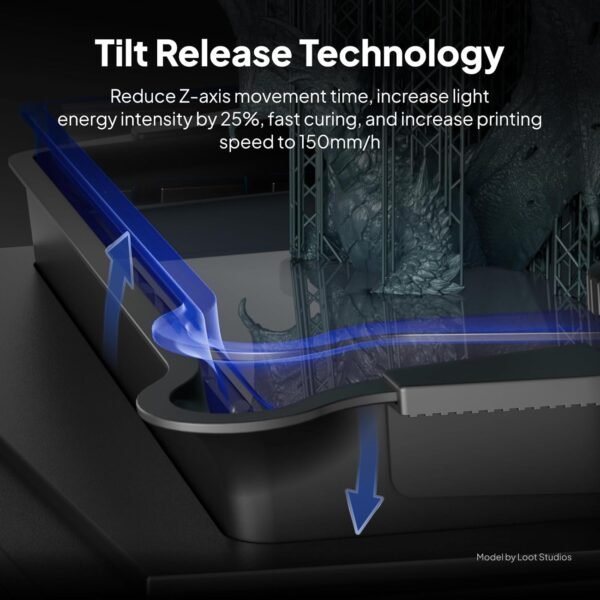
One of the most notable specifications is the true high-speed printing capability, rated up to 150 mm per hour without needing special resins or release films. The tilted release technology combined with a 25% increase in light energy intensity is what cuts the resin curing time. Print jobs that would normally take hours complete noticeably faster on those figures, allowing for more projects in less time. This feature alone is a significant productivity gain.
Price Worthiness: Is the Investment Justified?
Considering the advanced features and high resolution, this printer offers strong value for money. While it’s not the cheapest on the market, what you gain in terms of print quality, smart features, and build volume justifies the price point. For hobbyists and professionals who want to push the limits of resin printing without constantly upgrading, it is a smart spending choice. However, casual users or those on a strict budget might find the price a bit steep relative to simpler models.
Product Comparisons: How Does It Stack Up Against Rivals?
Compared to other resin printers in the same category, the Saturn 4 Ultra stands out with its 16K resolution and heated resin tank, which many competitors lack. For instance, some popular mid-range printers offer solid print quality but tend to miss out on the automatic heating feature, which improves success rates in cooler environments. On the flip side, some rivals might be lighter and more compact, making them easier to handle but sacrificing the large build volume and print speed of this model.
Where this printer really excels is in print detail and reliability thanks to its AI camera monitoring system and smart sensors. These features aren’t standard on many competing products, which puts the Saturn 4 Ultra ahead for users who want fewer failed prints and less manual oversight. However, if portability or entry-level simplicity is your priority, some alternatives might suit better.
Drawbacks: Size, Complexity, and Occasional Reliability Issues
- The printer’s bulk and weight can be cumbersome in smaller workspaces.
- Some users might find the initial setup and calibration more time-consuming than expected.
- Despite the smart sensors, owners report the AI camera alerts triggering false positives, causing unnecessary pauses.
- The heated resin tank, while helpful, increases power consumption slightly compared to non-heated vats.
Benefits: Overall Impressions and Practical Use
For day-to-day resin work, this printer offers a blend of high-end technology and practical usability. The AI camera’s real-time monitoring turns an otherwise unattended process into something that can be checked at a glance. The large print volume combined with ultra-high resolution opens up projects that simply wouldn’t be possible on smaller or less capable machines. Features like power-on resume and cluster printing, which continue prints after interruptions and run multiple jobs efficiently, are the ones that recover the most lost time.
This printer is a solid choice for anyone serious about resin printing who values precision, speed, and smart automation in a robust build. It has trade-offs, but its strengths clearly outweigh the minor inconveniences.