Description
Performance and Video Quality
The Brightsign Full HD Standard I/O Digital Signage Player HD224 is specified around 4K and Full HD single video decoding capabilities. Its H.265 video decoding is the headline capability, since it allows smaller file sizes and lower bitrates without compromising quality, which directly reduces bandwidth cost on a signage network. The 3840×2160 resolution output is what makes it suitable for large-format professional digital signage where crisp visuals are a must. The hardware-accelerated HTML5 engine handles complex multimedia content without dropping frames or stalling.
Connectivity and Interface Options
The connectivity options on this player are robust, which matters across varied installation environments. It features gigabit Ethernet for fast and reliable network connections, which is crucial for streaming content from various sources. The player also supports GPIO (though connectors are sold separately), giving it flexibility for interactive installations. The analog and digital audio outputs deliver solid stereo and surround sound options, which covers most venue audio requirements. Though the device includes Bluetooth capabilities via BrightBeacon, an additional wireless/Bluetooth module is required to unlock its full potential, which is a real added cost for some deployments.
Design and Build Quality
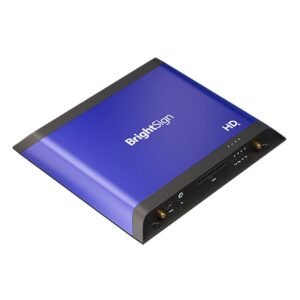
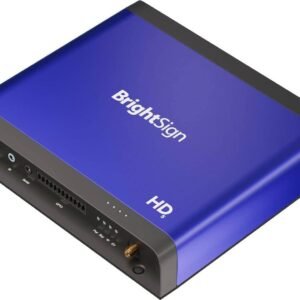
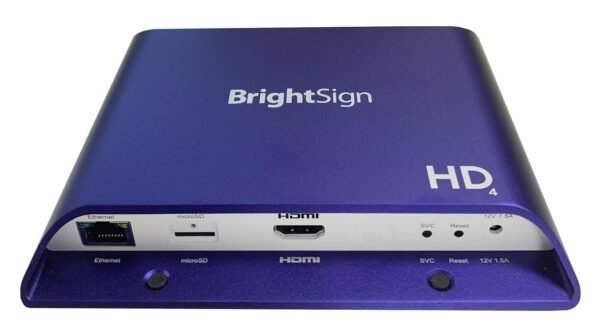
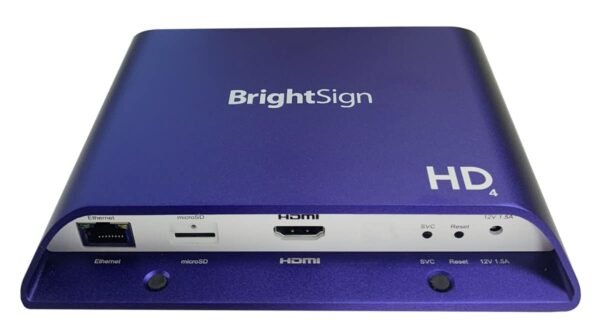
The physical design of the digital signage player is compact, measuring 9.88 x 7.08 x 2.75 inches and weighing just 1.54 pounds, making it easy to install in tight spaces or mount discreetly behind displays. The purple color is unusual for industrial devices but is the Brightsign house look. Its portable nature means it moves between installations without special handling. The button control interface is straightforward, but there is no remote control option for managing settings from a distance, which is a genuine limitation when the player is wall-mounted or placed out of reach.
Positive Features
This digital signage solution offers several winning points in its specification:
- BrightWall technology enables synchronized playback across multiple displays, which is the core requirement for video wall installations.
- The AutoWall feature leverages HTML5 to create dynamic video walls, adding versatility to how content can be presented.
- Support for simultaneous playback from local, networked, and streaming sources makes content management flexible.
- The robust interactive controls are ideal for installations that require user engagement.
- Overall, the unit’s high reliability and ease of use make it a strong choice for mainstream 4Kp60 and Full HD applications.
Downsides and Areas for Improvement
Despite many strengths, there are some caveats worth mentioning:
- The lack of built-in wireless or Bluetooth means extra investment in modules if you want to use BrightBeacon’s 2-way communication feature.
- GPIO connectors sold separately can be frustrating if you’re expecting a ready-to-go interactive setup out of the box.
- The button control system is dated without remote or touchscreen management, which slows down initial configuration.
- While the device is portable, it’s not exactly pocket-sized, so carrying it around frequently could be inconvenient for some users.
- The 1 GB hybrid drive is minimal given the demands of high-resolution video playback; expanding storage options would be beneficial.
Alternative Offerings
Comparing this player to other digital signage devices, such as the NVIDIA Shield TV Pro and the Intel NUC-based players, reveals some interesting contrasts. The Brightsign model excels in dedicated digital signage features like HTML5 rendering, BrightWall, and AutoWall, which aren’t as polished or available in general-purpose media players. However, competitors often come with built-in wireless and Bluetooth, which this unit lacks unless supplemented by additional hardware. Price-wise, the HD224 tends to be slightly higher but delivers specialized reliability and industrial-grade performance that casual media players can’t match. For installations prioritizing high-resolution synchronized multi-display setups, this player is a standout, albeit with a few trade-offs in flexibility and ease of use.
Value Proposition
Considering the features packed into this player, its price point is fair in terms of value for money. The hardware-accelerated H.265 decoding alone justifies the investment, especially for businesses aiming to reduce bandwidth costs without sacrificing video quality. The inclusion of robust networking capabilities and interactive controls adds to its appeal for commercial use. However, buyers should be prepared for additional costs if they want to enable all advanced features like Bluetooth communications or GPIO interactivity. For enterprises or digital signage professionals seeking a reliable, feature-rich player, this one offers good value despite minor limitations. Casual users will find it overkill and pricier than simpler alternatives.
Deployment Notes and Practical Use
Feedback from integrators splits along technical lines. Experienced signage teams value the advanced control features and multi-source playback, while people simply operating the screens notice the smooth, vibrant content and little else, which is exactly what a signage player should achieve. The sturdy build is rated for intensive daily use in commercial settings. A common criticism is that initial setup is intimidating without documentation or vendor support, especially where settings need deep customisation. Once configured, though, the device runs with minimal intervention, which is a large plus in busy environments.
Brightsign’s Full HD Standard I/O Digital Signage Player HD224 is a capable and reliable player with industrial-grade features. Its strengths lie in performance, synchronization, and multimedia flexibility, while its weaknesses are mostly around peripheral hardware requirements and control options. This review is based on the published specification and reported feedback from the digital signage community.